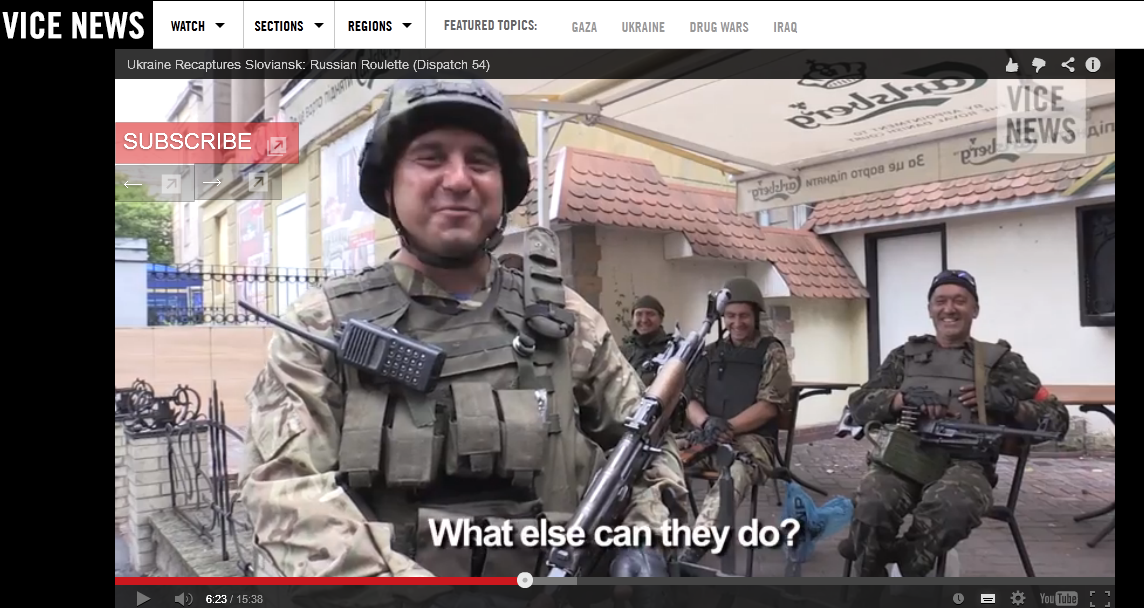
In Part 1 we’ve looked at the basic facts of the so-called
Slavyansk Crucifixion and the helpful investigations by Anatoly Shariy and
Evgeny Feldman, but now it’s time to consider the work of the real debunkers.
We’ve already met Julia Davis through her role in the Fake Picture Scam, but since she’s likely to be a recurrent figure in any discussion
of media distortion she merits a few words of introduction of her own.

Julia Davis calls herself a ‘whistleblower’, and so indeed
she is - but where others have championed ordinary people against the
oppression of the US government, Ms Davis’ contribution was to blame the US
government for not being oppressive enough. Brave she may have been, victimized
she certainly was – but Daniel Elsberg or Chelsea Manning she ain’t.
What she is is a matter of public record. She’s employed by
the US Dept of Homeland Security, and since she spends most working days
tweeting and blogging in support of Kiev it’s not hard to guess what that job
really entails. In fairness we should also say that this is clearly a labour of
love. Ukrainian by birth, she evidently shares the nationalist ideals of
Svoboda and the Right Sector, and when she’s not gloating over the bodies of
dead Russians she enjoys little jokes about Moskals and Colorado beetles.


But being an unpleasant person doesn’t necessarily mean
she’s a liar, so we should give her ‘debunk’ of the Slavyansk Crucifixion the
courtesy of proper analysis. Here's how she kicks off:

Strong stuff! Take that, Colorados!! But let's look a little closer.
First claim – ‘out of the entire town of Slavyansk, not a
single witness’. Seriously? She seems by her link to be referring to the Feldman video,
but can she really be saying that the ‘entire town of Slavyansk’ comprises just
these dozen people? Even if we forget the fact that no-one under occupation is
likely to confirm this atrocity on camera, no-one can be expected to take this sweeping statement seriously.
And in fact there are already rumours of a second witness. The source is biased - the Novorossiya PR page that posts under the generic name of Colonel Strelkov - but on 11th July a post claimed that a girl from Slavyansk had already written to say a militiaman's child had been killed and a video of the murder sent to the father:

It may be a different murder. The girl who wrote in may have been lying. The girl may not have existed at all, and it's 'Strelkov' who's lying. But it's at least a possible second witness, and it seems rather disingenuous not to mention it. At the very least...
Second claim – ‘inspired by the 4th season of The Game of
Thrones’. Hmm. I don’t personally share Ms Davis’ confidence that people undergoing
massive bombardment have nothing better to do than watch American pulp
television, but it’s at least true that Season 4 of this gore-for-entertainment
show did indeed air in Europe in April and Galina Pyshnyak might have seen it. But so might other people. If there really is a link between television violence and serious crime, the studies so far suggest that
it inspires not fantasists but perpetrators. Did it inspire some Right Sector
elements who were bored with burning people alive and wanted to try something
new? I have no idea whether it did or not, but the ‘Game of Thrones’ connection
actually makes the crucifixion more likely rather than less.
Let's move swiftly on to the facts.

Third claim - 'There is no Lenin Square in Slavyansk'. Really, Ms Davis? Then what’s this from veeoz?

And this from America’s own Getty Images?

Or this, also from Getty Images?

The square is bordered by Lenin Street and has a huge great statue of Lenin in the middle - what else would the predominantly Russian-speaking population of Slavyansk call it? The Ukrainian government mark their maps with the less politically odious
‘Oktober Revolution Square’, the cautiously neutral call it ‘the central square’,
but most genuine locals call it ‘Lenin Square’ and so
does pretty well everyone else. Look at this, for instance, from Canada’s StarPhoenix:

Or this from America’s Business Insider:

I'm sorry, but there is a Lenin Square in Slavyansk, and Ms
Davis’ statement is palpably false. All she's proved here is that she doesn’t
know much about Slavyansk – but Galina Pyshnyak does.
Fourth claim - ‘There are no bulletin boards on the main square in
Slavyansk.’ Well, I’ve never been to Slavyansk and can’t vouch for the
accuracy of this, but I couldn’t help noticing the caption on this image from a
now inactive Slavyansk webcam:

Yes, the ‘central square’ is indeed the same as Lenin Square (see here,
for instance, and here) and if we take a closer look at that object on the
right I’m bound to say it looks awfully like a bulletin board.

But let's be fair about this, and consider other
options. The second crucifixion anecdote pointed out by Anatoly Shariy in Part
1 refers instead to an ‘ad board’, a ‘sign for advertisements’, which doesn’t
fit so well with this image. The only ‘ad signs’ in Feldman’s video are so high
as to be impractical for the purpose, and I think we should be looking for
something more like the object in background here.

Or here.

You’ll recognize the benches and bins here, but the pictures
are actually stills from that same episode of ‘Russian Roulette’ we discussed in Part 1, which shows
these women collecting food and humanitarian aid – in Lenin Square, Slavyansk.
So much for Ms Davis’ facts.
Fifth claim - 'The depravity of the story, allegedly witnessed
by the entire town of Sloviansk, is enough to discount it as pure fiction.’
Sorry, but – no. Of course it’s hard to believe, any decent person would
struggle with it, but we’ve already established in Part 1 that history is full
of such depravity and it would be wilful to pretend it doesn’t exist. Perhaps
Ms Davis thinks with the Right Sector that the Holocaust is fiction too?
Sixth and last claim - Ms Davis’ pièce de resistance from
which she derives her headline: ‘Russia’s madman ideologue Dugin scripted fake
baby crucifixion in Ukraine’. Her argument is that it was Dugin who first
created the idea of a child crucifixion on his Facebook page, and that Galina
is merely following his ‘script’.
An interesting idea. Aleksandr Dugin is a nasty piece of work whose exhortations to ‘Kill, Kill, Kill!’ put him in the same
murderous league as Yulia Tymoshenko, so if Ms Davis can indeed mark him as the instigator of the crucifixion story then
that would certainly be very damaging.
Unfortunately she can’t.
For a start, Dugin isn’t the first to break this story, and
Ms Davis isn’t the first to spot the similarities. The version on Dugin’s
Facebook page is the same already quoted by Anatoly Shariy, and it’s time we
looked at it in detail.
The story purports to be an eyewitness account given in a
garbled manner over the telephone. Here's the key section, with thanks to Marcel Sardo for translating the tricky bit in the middle:
‘The Ukrainian forces entered the city, they had information
about who is in the militia, they captured a woman, and tied a man by the legs
to an armoured transport vehicle and dragged him alive around the square, then
threw him all bloodied into the vehicle and took him away somewhere. Then
people came to an apartment, took a six year-old boy, brought him to the square
and nailed him to an advertisement info board and he was hanging there until
the father, who was a militant, was brought there too. When the father came
they shot the boy before his eyes. Igor and his daughter watched them do it,
the girl had a stress so deep she started stammering, still can't speak properly,
and she's twelve…’
This version appears three whole days before Galina’s, yet
both the main elements are there: someone being dragged behind a military
vehicle, and a child being crucified in front of its parent. What does this
mean, and what are the implications?
Whatever they are, this is most clearly NOT a ‘script’ as Ms Davis claims. Here the boy is six, where Galina’s is three. Here the witness is the father, where Galina’s is the mother. Here the child is shot, where Galina’s takes an hour and a half to die. If this Facebook version was intended as a propaganda script, then why on earth did Galina tell such a wildly different story?
Whatever they are, this is most clearly NOT a ‘script’ as Ms Davis claims. Here the boy is six, where Galina’s is three. Here the witness is the father, where Galina’s is the mother. Here the child is shot, where Galina’s takes an hour and a half to die. If this Facebook version was intended as a propaganda script, then why on earth did Galina tell such a wildly different story?
There has to be another explanation, and there are at least
three to consider:
That neither story is true. Wild rumours circulated among
the frightened inhabitants of Slavyansk, and some (including Galina and the
source for the Facebook version) pretended to have witnessed them first hand.
They might have done this for attention, or in a bid for Russia’s sympathy and
help.
That both stories arise from the same source, which might
have been a real atrocity or perhaps only the threat of one. In that case Galina
either decided independently to make it even more heart-rending, or didn’t know
the details and had to make up her own when she claimed to have witnessed it
herself.
That there were two separate incidents. It’s actually very
rare to find an isolated atrocity of this type, and war crime investigators
would typically expect to find others. If it seems strange Galina doesn’t mention
the first incident in her interview, we should note that her first interview makes a clear
distinction between things she knows (the shootings) and the incident she saw
herself (the crucifixion).

It would still help to find where the Facebook version originated
– but it wasn’t with Dugin. Ms Davis is again being economical with the truth when she says he posted on 8th July, since the timestamp on his Facebook page shows 9th July at 14.20 - and other people
had already shared the story before that. Like this Yuri Golubev, for
instance.

But the biggest irony is that if Ms Davis had actually bothered
with real research instead of throwing random mud, she'd have found
something quite as damaging as Dugin. I did, and since I’m more interested in truth
than partisanship I’m happy to make her a present of it.
Golubev may have been the first individual to ‘share’ that Facebook
story, but the source he linked back to was this, posted 8 minutes earlier:

It’s a Russian organization for benefiting the State, and its home page defines their mission as ‘to promote a positive image of Russia’. It's a private charity rather than a government body, but its purpose is still essentially propaganda.
That’s about as damaging as it gets – but if we actually think
about it, it still doesn’t prove either story is false. Russian propagandists
certainly made enormous play with Kiev’s airstrike on Lugansk – but that doesn’t mean it didn’t happen. Such organizations highlight, exaggerate, distort and exploit
genuine material all the time, and any story of this kind would have made it
into their hands within minutes. They may have invented the Facebook story,
they may have simply been told about it, but we can’t yet be sure either way.
What we can be fairly sure about is that Galina’s story didn’t
originate from here. If they’d wanted to invent a witness, surely they’d have
coached one to say the story already broadcast – not to give a version so
different it laid the entire concept open to suspicion. Surely they’d have planned
the timing – but Galina’s story so obviously took them by surprise that they
didn’t even have a Channel 1 team on the spot. That whole ‘first interview,
second interview’ business smacks of amateur reality, and not the kind of
streamlined affair we’d expect of professional propagandists.
So the jury’s still out on Galina’s story – but not, I’m
afraid, on Julia Davis’ attempt to debunk it. She may not be deliberately
lying, it may simply be an unbelievably shoddy piece of research, but not a
single statement stands up to scrutiny, and the effect of the whole piece is
smug, hateful, and pervasively dishonest. She deserves credit for at least posting her opinions under her own name, but her work is consistently unreliable and she can't be recommended as a trustworthy source on Ukraine.
But I’m afraid she’s not the worst.
Enter, hatchet in hand, Owen Matthews of the UK’s The Spectator,
who wants the Slavyansk Crucifixion to flesh out an article with the open-minded title of ‘Vladimir Putin’s Empire of Lies’. Here’s what he makes of
it.

Oh dear, oh dear. Let’s pass swiftly over his repetition of
the ‘no Lenin Square’ lie and regurgitation of the ‘Game of Thrones’ link
(which at least he has the decency to admit is only rumour) and look at his
terrible new accusations.
Most aren’t actually accusations at all – merely repetition
of known facts distorted to sound like crimes. Galina admitted openly in interview
that her husband was fighting in the militia, so this is hardly an astonishing
discovery. The fact he was also a former member of Berkut comes directly from
the statement of the Kiev Interior Ministry, and the unpleasant slant given by
the words ‘notorious’ and ‘disbanded by Kiev’ is a travesty of honest
reporting. It’s true the Berkut were accused of the Maidan sniper killings and
disbanded in disgrace – but also true that subsequent investigations revealed
the snipers were from the protestors rather than the police, and even the Kiev
government has finally admitted the Berkut were innocent all along.
But what's really unfair is the central plank of this
extraordinary attack – the revelation that Galina Pyshnyak from Skavyansk is
really an actress from Obukhov called Galina Astapenko, which naturally implies
her entire story is a fabrication. What’s clever about this accusation is that
there’s really only one lie in it, but the whole thing is utterly, provably
false.
Mr Matthews didn’t bother to cite any sources for
his revelations, but after completely failing to find any references, images,
or IMdb listing for ‘actress’ Galina Astapenko, I did manage to retrieve an article which might have prompted his misleading statements:

Run this through Google Translate, and you’ll see it
doesn’t actually make any of the claims reported. Galina did indeed used to be
called ‘Astapenko’ – because that was the name of her first husband. Someone should tell Mr Matthews that quite a lot of women change their names when they
marry or remarry, and it doesn’t actually mean they’re pretending to be somebody
else.
Quite a lot of women move house too. The Kiev Interior
Ministry has already confirmed Galina lived at Nikolayevka outside Slavyansk
before she fled to Russia, and Galina already said in her interview
that she originally came from the west. All this article does is confirm where
she was living at the time of Maidan – and I really don’t see
anything wrong, criminal, or misleading in that.
But the killer blow would be if Galina were indeed an
actress, since the story's strongest point is the power of her
performance. But she wasn’t. There’s no trace of such an actress, and it would
take a very eagle-eyed viewer indeed to recognize one who’s never appeared in
any film or television at all. Literally the only combination of the words ‘Galina
Astapenko’ and ‘actress’ I could find are in this article, and the translated
sentence looks like this:

She ‘became’ an actress for the story of Yulia Chumakova –
the woman suspected of inventing the crucifixion story. In other words, the
article only says that Galina is acting in the witness interview, not that she was
one by trade or had ever done such a thing before. It is simply another way of
saying ‘she is a liar’.
The established facts then are these: Galina was married
before to a man called ‘Astrapenko’ and she used to live near Kiev before she
moved near Slavyansk. I try to be charitable, but can somebody please explain
how an honest journalist could distort those facts into ‘But sharp-eyed viewers
recognized the ‘refugee’ as actress Galina Astapenko from Obukhov, near Kiev’?
But there's still one remaining claim – that ‘according to recent
posts on her social networking page’ Galina is enjoying summer with her children. Well, how awful. How shocking to take away traumatized
children who’ve been bombed by their own government for months and try to give
them a nice time. But is it even true?
Galina’s Vkontakte page is now inactive, but I managed to track down a screenshot of the final entries:

She last logged in on 11th July, the day of her interview.
The only legible entry before that was on June 25th and merely shows
activity from some online game. Dreadful, of course, for a woman in wartime to
try and do anything so normal, but I don’t myself see anything about ‘enjoying
summer’ – and certainly nothing from the time she fled to Russia.
But Owen Matthews isn't the only one to exploit Galina's social media as if its mere existence is somehow wrong. Both the podrobnosti article and Julia Davis’ piece have
plundered it for past photographs, fostering the illusion that Galina Pyshnyak can’t
be the half-starved refugee she appears to be because the real woman actually
looks like this.

It’s ludicrous, of course – like trying to discredit a
concentration camp survivor by showing happy pictures of them before the war –
but there’s no doubt the subliminal effect is somehow damaging, and ‘damage’ is
what it’s all about.
And that's shocking from The Spectator. Ms Davis has a
clear political agenda, but The
Spectator used to be one of Britain’s most highly respected publications, and
Owen Matthews is an excellent writer whose ‘Stalin’s Children’ I’d have previously
recommended. What is going on here? What possible pressures could reduce them
to publish something so deliberately and blatantly misleading?
Maybe they just didn’t bother to research. They know there’s a
market for material demonizing Putin and Russia, and any old garbage will do. No-one’s
going to care enough to check what’s written, and a poor refugee is in no
position to sue anyway. Why waste time on a ludicrous allegation everyone
already knows is a lie?
But they don’t know, and that’s why it simply has to be
investigated.
Here’s what we’ve now established in the two parts of this
mammoth post:
- That Galina Pyshnyak is who she claims to be, did live where she claimed to live, and knows Slavyansk well enough to be familiar with Lenin Square – and its bulletin board.
- That her husband was indeed fighting with the militia, which would have put her in danger exactly as she claims.
- That she spoke the truth about only ‘women and the elderly’ being left in Slavyansk. That this was not the case when the soldiers first came (as we saw in the Russian Roulette episode) but does appear to be so now.
- That the people of Slavyansk are clearly frightened, and very reluctant to say anything about their occupiers.
- That other people have also talked (apparently independently) about a child crucifixion in Slavyansk. They may be lying, but they’ve talked about it – and before they could have seen Galina’s interview.
- That she has never been an actress, yet has turned in the kind of performance that wins Oscars.
None of this proves anything – except that there’s surely enough
to warrant investigation. I suspect the only obstacle is the inherent ‘unlikeliness’
of the story, but as I argued in Part 1 we know there are people in Ukraine
more than capable of doing such a thing. In fact we know more than that – we know
that they were there.
It’s been kept very quiet, and I only stumbled over this one
by accident when I was researching Lenin Square. On 8th July the BBC published
a report by Steve Rosenberg on the liberation of Slavyansk, and near the end you’ll
find this one telling paragraph.

That chilled me. It was always hard to believe the ordinary
Ukrainian army (many of them reluctant conscripts) would even contemplate such
an atrocity – but the Right Sector were there on exactly the right day, and this is just the kind of thing I’d expect them to do.
You don’t believe me? Have a look at this video they
published way back in April, where they cut the throat of a former Donetsk
police chief in his own bedroom – and in front of his own wife. But be warned – it’s
very graphic.

Maybe it’s faked. Maybe. But Odessa wasn’t faked, and they
did that too. They even filmed themselves throwing molotov cocktails, smashing
the doors down, kicking and mocking the bodies afterwards – they did it all
without fear because they knew no-one would bother to investigate. The fact that they were right means they must be even more confident now.
If we ignore the Slavyansk Crucifixion then we're emboldening them even further. We’re sending a
message to Ukrainian forces that they can do whatever they like to the people
they ‘liberate’, and no-one will ever punish them for it. We are giving them
carte blanche to commit rape, torture and murder.
We MUST investigate this allegation properly, even if it proves to be false. If we don't - then the next one will be true.
We MUST investigate this allegation properly, even if it proves to be false. If we don't - then the next one will be true.